
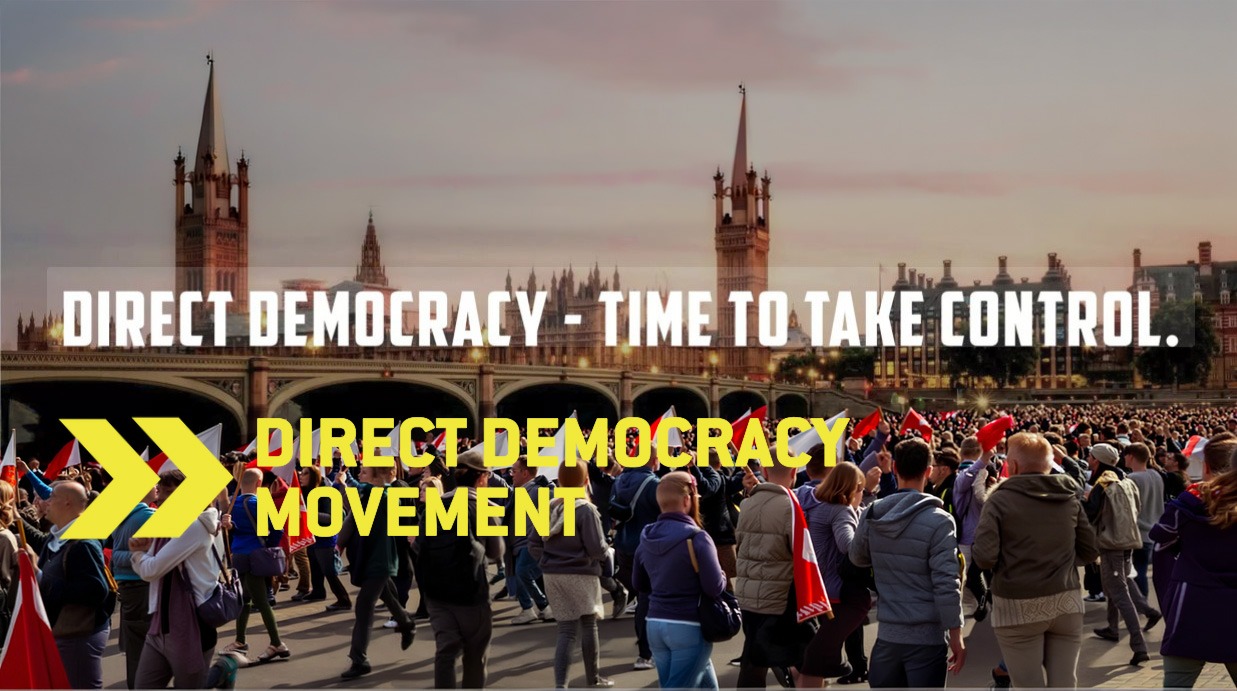
Manchester – Direct Democracy
On Tuesday 23rd June 2026 (the tenth anniversary of the EU Referendum), Politics in Pubs met to discuss the Direct Democracy Movement. We were delighted to welcome guest speaker Neil Petrie, author and former intelligence officer, to introduce this topic and lead the discussion.
Introduction
In 1848, Switzerland introduced a system of Direct Democracy which enables its citizens to participate in Government decision-making. Alongside a government of elected representatives, there is a system of national referenda enabling voters to participate in the decision-making process. For any change in the national constitution, a referendum of voters is mandatory. For any change in the law, a referendum is optional. In addition, if enough citizens wish to initiate a referendum on a particular issue, they have that option too. Switzerland holds four referenda a year. Could that system work in Britain?
About the Direct Democracy Movement
“The problem is not in the system. The system itself is the problem.”
The Direct Democracy Movement
Imagine a world where your voice truly matters. A world where voters, not politicians, decide the laws and policies that shape their future. The Direct Democracy Movement believes in empowering people to take control of their governance through transparent, inclusive, and effective direct democracy systems. A growing number of nations and localities recognise the benefits that voters bring to their policy-making process and have adopted direct democracy. The Direct Democracy Movement asks:
- Do you want to have a say in major decisions affecting the nation?
- Are you concerned that the political class is too ready to listen to special interests and not voters?
- Does the assault on freedom of speech and other liberties worry you?
- Do you want to do something to improve our democracy and protect our freedoms?
- Do you want to defend our values, our culture and our community by making politicians our servants and not our masters?
The elite problem
Neil began by stating that Britain has a problem with elites: we have an organised minority running things on behalf of their backers rather than in the interests of the people (the disorganised majority). Labour is controlled by the Fabian Society. Tories are controlled by the city. In politics the objective is to penetrate groups in order to control the policy. Some call it ‘lobbying’. It is the intelligence equivalent of ‘handling’. There are many examples of where our elected representatives are ‘handled’ by others who are not elected and not acting in Britain’s national interest. Britain’s system of democracy is a sham because elected representatives are not making policy in the interests of the population, and the population is almostly entirely excluded from making decisions about policy. (The last time there was a referendum in Britain – on whether to leave or remain in the EU – folk voted the ‘wrong’ way and our elites tried to overturn the result). Neil described it as an elective dictatorship. We need to change the system to enable participation in decisions about policy by those affected by the policy – i.e. the British people.
Change the system not the leader
Albert Venn Dicey KC, FBA (1835-1922) wrote extensively about democracy, the rule of law, and the principles of England’s uncodified constitution. He believed that the referendum places the nation above the parties or factions and observed that in Switzerland ‘the electors are the sovereign power’. He stated that:
“… the main use of the referendum is to prevent the passing of any important Act which does not command the sanction of the electors…..”
Neil described that, because of Direct Democracy, Switzerland’s politicians are much more focussed on nationalism than globalism and, as a result, its citizens are more satisfied with the policies governing their lives. The Swiss have a more accountable government, good public services, low crime, greater satisfaction, and a more cohesive society than in other nations.
Watch this space!
People in the UK are now ready to reject the government’s hard power control tactics as a means of governing the country. The UK’s Government hasn’t been considering the views of its people, which they are meant to represent, for a very long time. Decisions on key issues impacting us all are made by a few, in isolation. We have also seen unprecedented levels of corruption and greed, with a total lack of accountability to the electorate of those in power.
The only party leader to publicly acknowledge the benefits of Direct Democracy is Nigel Farage of Reform UK. Neil has been working with Reform UK-led councils to discuss the introduction of referenda in local decision-making. Watch this space!
Conclusion
In Neil’s view, now is the time for everyone to play their part in regaining control of the country’s destiny, not just for our generation, but for our children, grandchildren and for generations to come. This new alternative is powerful, it’s sustainable and will return control to the people by considering everyone’s views. It will share power as widely as possible and by its very nature will make government directly accountable to the people. We are talking about introducing a truly Democratic government, one founded on the principles of Direct Democracy.
Discussion
Q. How do the Swiss manage to hold four referenda in a year? The EU Referendum here is Britain in 2016 took months of debate and cost.
A. Britain’s current system of democracy via representation isn’t working and we are heading for a disaster. We must set a timetable for changing the system to a hybrid system which is part representative, and part direct democracy via referenda. And the results of each referenda must be generally accepted.
Q. The hybrid system would require the relinquishment of some power. Isn’t there a vested interest in not giving up power?
A. Our current system is in crisis – partly because of the ‘handling’ of our politicians by lobbyists like other nations, big corporations, trade unions, etc, in order to influence policy and laws in their own interests. It needs revolution and evolution so that more power is directed into the hands of the people.
Q. How would the referenda work in this country?
A. The Direct Democracy Movement would work with councils and show them how to set them up – we would show them the path ahead and inspire them to follow.
Q. What is the average turn-out in Switzerland?
A. About 48% but it varies depending upon the issue being voted upon – some are more emotive than others so turn-out varies.
Q. Some parts of Switzerland are more French, and some are more German (with high trust values). Does the response to a referendum vary across the country?
A. There are different cultural values across Switzerland. Direct Democracy is not a perfect system but it is a lot better than ours. The Swiss have higher satisfaction levels than us and they are not controlled by a tiny minority looking out for their own interests.
C. The hybrid system is a really interesting idea. The current system is definitely the problem. People want to be listened to but they don’t trust their politicians. During the EU Referendum people voted against what they were being told and witnessed to resulting onslaught.
Q. Division is a natural feature in an argument but it is weaponised to keep the peasants arguing. Direct Democracy needs emphasis upon knowledge and genuine argument – but whose argument and who is financing it? How do people make space to inform themselves about issues when they are busy working to provide for their families?
A. People don’t have to be experts to vote. Look at the jury system we have in this country – jurors are not experts in the law and voters don’t have to be experts in order to vote.
Q. Referenda can’t be a substitute for political parties – there is a danger it could be massively manipulated.
A. The Swiss hybrid system is a mix of referenda and representation and we could have that here.
Q. Direct Democracy is a very appealing idea. However, special interest groups will want to hang on to their power. Could it bring us to civil war?
A. It’s really important to be working from the bottom up to offer a solution. We are looking for evolution not revolution.
C. A principle underlying the Magna Carta is that the State answers to the people. Referenda are certainly one way to return power to the people. In court, the accused is judged by a jury of his/her peers, not by the state. Blair took power and gave it to quangos and supranational bodies. He replaced the Law Lords with the Supreme Court. Power needs to be returned to Parliament and MPs need to be more capable of making decisions.
C. In the ebbs and flows of having an organised working class, we are currently in a downturn. The Chartists achieved most of their aims. All adults can now vote in general elections. Participation in referenda may galvanise the working class and convince them to organise once again in order to change the system.
Q. The Swiss system looks very good. How realistic is it that we might get it here?
A. Nigel Farage is generally supportive of referenda so Reform UK-led Councils are a good place to start.
Politics in Pubs would like to thank Neil for an excellent introduction to the Direct Democracy Movement. Thanks also to our excellent hosts at The Welcome Inn. Cheers all!
If you would like to find out more you can check out the Direct Democracy Movement website www.ddrightnow.com and Neil’s book https://ddrightnow.com/books#one-vote-away-saving-the-west-by-neil-petrie.


