
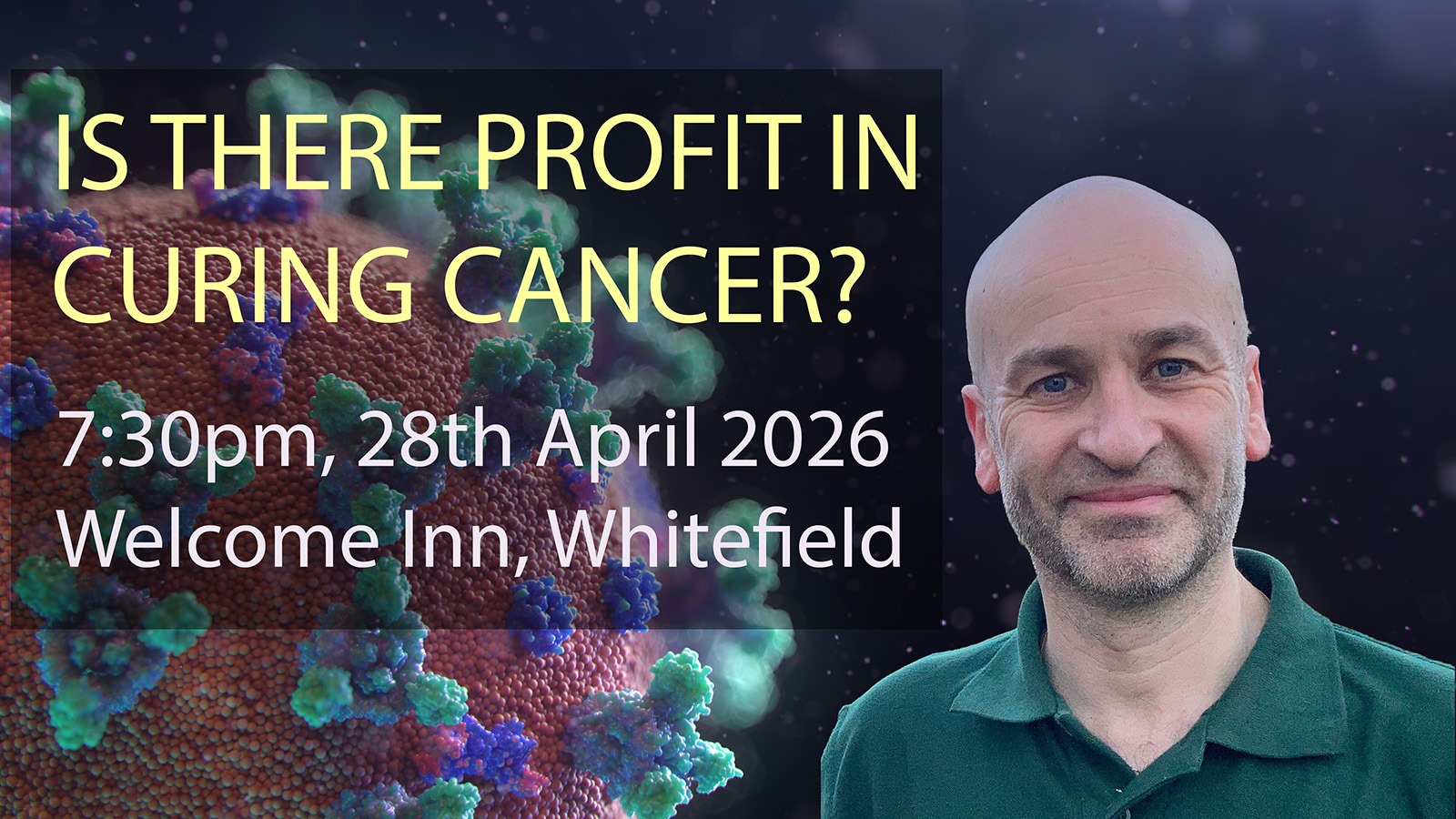
Manchester – Is there profit in curing cancer?
On Tuesday 24th April 2026 Politics in Pubs met to discuss cancer: its prevalence, causes, and treatments, and who profits. The topic was introduced by Neil Jones, former Therapy Radiographer (cancer treatment using radiotherapy). Neil began with a disclaimer:
The information provided by the presentation is not intended or implied to be a substitute for professional medical advice, diagnosis or treatment.
Neil’s presentation (opens in a new tab or window).
Discussion
Q. Current cancer treatment protocols and regulation don’t allow for best practice, they seem to inhibit it, preventing better ideas and practice from being explored. Renowned oncologist Angus Dalgleish agrees that, from a cancer point of view, sugar is bad and healthy fats are good. Would you agree that some vaccines may also be making it easier for cancers to develop because they disturb the immune system?
A. Some vaccines contain known carcinogens like mercury, PFAS and formaldehyde which can lead to mitochondrial damage. Mitochondria are the cell batteries and conductors – they signal when a cell should divide or die. Mitochondrial damage can lead to cancer.
Q. Is a ketogenic diet effective once a tumour is already present?
A. Cancer cells feed off glucose but they also use glutamine which is a common amino acid found in protein. Prevention is always better than cure but reducing glucose in the blood by diet and intermittent fasting is a key to optimising metabolic health and depriving cancer cells of their energy source.
Q. Is immunotherapy an effective treatment?
A. Immunotherapy uses an anti-body to attack a specific protein on the cancer cell. It is targeted but can have horrendous side-effects.
Comment – It is ironic that the £50 million required for a gold standard clinical trial of a metabolic approach to cancer treatment isn’t available yet the UK Government is spending £600 billion on Net Zero schemes.
Comment – Medical advice is always evolving – a few decades ago doctors advised people to smoke, they conducted lobotomies, and now the trans debate is being converted into a new market for drugs and surgery.
Q. Are AI language models useful for researching medical papers?
A. Yes but it depends who is programming the AI models – you need to check that the results concur with the original paper.
Q. Is there a risk in portraying the macro vs micro level as good or bad i.e. that medics and big Pharma is only interested in profiteering and a healthy life-style will inevitably lead to less chronic illness?
A. My main point is not a criticism of the staff involved in cancer treatments but that the current treatment paradigm and protocols trap them into one approach at the expense of others. One of the side effects of cancer treatment is muscle wastage and those patients are often advised to consume sugar-laden energy drinks to put weight back on, without considering the sugar’s adverse effect upon metabolic health.
Q. What role do toxins like microplastics, pesticides, fake sugars and other hormone disruptors play in cancer?
A. These toxins seem to inhibit the ability of cells to respire properly. Knowledge is power and an awareness of the effect this can have on our bodies helps us as individuals to make choices which reduce our exposure to them.
Comment – It is really important to remember that doctors don’t know everything and they are restricted by the need to follow guidelines and protocols. As individuals we can take simple steps to inhibit the development of chronic illness rather than enhance it. For example, fructose triggers dopamine and can stimulate the desire to eat more. Ultra-processed foods increase our consumption of fructose.
Q. The mirrored increases in cancer and diabetes reflect how our lifestyle has changed in recent decades – with takeaways, snacking between meals, high sugar content in ultra-processed foods. While you couldn’t eat a bowl of sugar on its own, sugar combined with the perfect amount of fat is highly palatable and profitable for the manufacturer. Would you say the food industry is also bears some responsibility for the increase in chronic illness?
A. Yes – taking responsibility for our own health is key, including our metabolic health. Certain foods and sugar trigger insulin spikes which damage metabolic health and can lead to insulin resistance and diabetes. In the radiotherapy pre-treatment department when a doctor’s notes are checked for patient consent, I often noticed that some my patients were also diabetic (they were required to stop their diabetes medication prior to their dye test). Intermittent fasting enables the process of autophagy to take place – a kind of internal housekeeping cleaning function which reduces inflammation and the distress signals inflamed cells give off. What you eat and when you eat is key to facilitating this process.
Q. What role does stress play?
A. Stress triggers the Cortisol hormone which can cause damage to cells.
Q. Is the incidence of cancer higher these days or is there just more diagnosis?
A. It could be a number of factors including poor diet and lifestyle, exposure to toxins, or the profit motive to seek new patients. Even cancer charities are big multi-million pound businesses these days.
Comment – A ketogenic diet can be helpful but too much protein can lead to cells operating on ‘dirty fuel’. The amount of protein consumed in a day should be limited to a sufficient but not excessive amount. Eating like your grandparents did can be a good guide to simplifying your eating habits and reducing stress. Dr. Kelly A. Turner has written an excellent book about her research into ‘radical remissions’ based on ten practical and spiritual factors associated with patients who have recovered from cancer against all the odds.
Comment – People trust and rely on the state too much. Traditional remedies and alternative approaches to the treatment of disease are silenced. Elle MacPherson’s approach to her own cancer treatment caused controversy but it worked for her. Prevention of disease would lead to a shrinking of the NHS and less reliance upon the state.
Q. If it is true that there is a free self-help treatment for cancer and its prevention, why isn’t it being taken up? Where is the wider debate? The self-help approach could be seen as a green light for the government to tell us what to do and what or when to eat.
A. Knowledge is power – the problem is not the people it is the current treatment paradigm which cages people’s minds about their approach to cancer from a treatment and prevention point of view. You are basically your own lab and there are steps you can take to improve your general health and your metabolic system to reduce the risk of cancer and its therapies.
Politics in Pubs would like to thank Neil Jones for leading this fascinating discussion. We would also like to thank our wonderful hosts at The Welcome Inn. Cheers all!


