
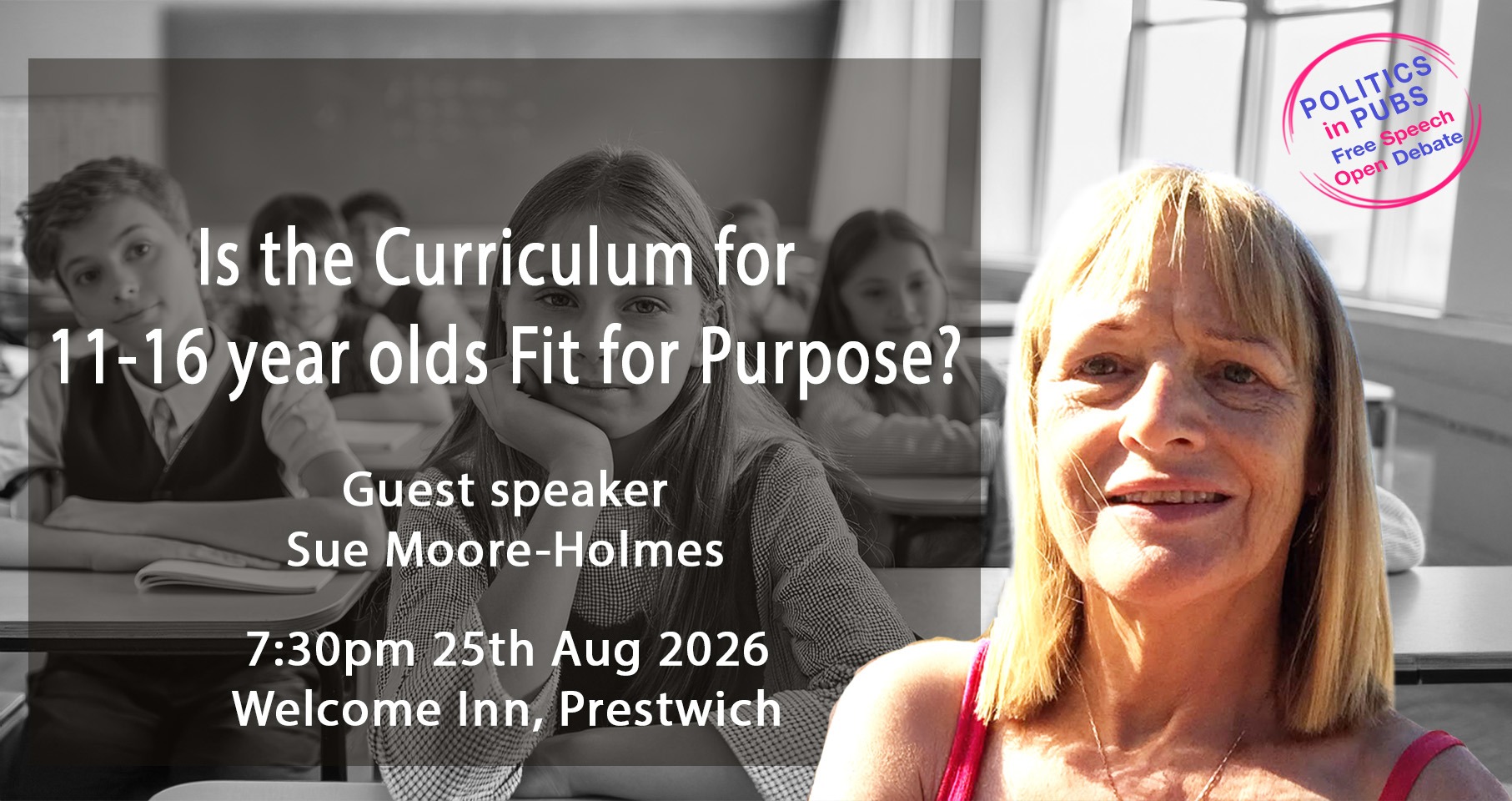
Manchester – Is the curriculum for 11-16 year-olds fit for purpose?
On Tuesday 25th August 2026, Politics in Pubs Manchester met to discuss whether the current Year 7-11 curriculum (for ages 11-16 years) in England is failing our children. We were delighted to welcome our guest speaker Sue Moore-Holmes, mother, grandmother and great-grandmother. An active volunteer, Sue has worked with children and families for over 50 years, qualifying as a social worker in 1987.
Introduction
Sue introduced the topic with the following: “As a woman in my 70s I was dismayed to see that my 16 year-old grandson has been studying the very same books that I did over 50 years ago. I found them boring then; he thinks they are entirely irrelevant. I would like to propose some different subjects for the core curriculum and present these to you with an overview of their content and why I think they are more appropriate to today”.
An ordinary person’s view
Sue explained that she is not a teacher, and hers is the view of ‘an ordinary person living in our extraordinary world’. Like her grandson, Sue enjoyed the social aspect of secondary school but found the lessons irrelevant and unengaging. She left school and progressed into a successful career without needing to use very much of what she had been taught at school. The National Curriculum now prescribes the following core subjects for Years 11-16 in state run schools: English language and literature, mathematics, science, humanities, languages, RE and PSHE. Sue argues that these subjects still hold little interest for today’s children. She proposes a drastic change in favour of a much more relevant set of core subjects.
Sue’s core curriculum
Sue’s proposal to educationalists is to replace the current core subjects with the following:
- Money management
- Critical reasoning
- Time management and organisation
- Understanding local and national democracy
Money management
This core subject would reject irrelevant topics like logarithms and algebra and focus instead on the financial realities of life to be encountered by children after they leave school. Functional maths teaching would help children to understand their payslips, savings, pensions, credit, debt, financial products like life insurance, and how to manage long-term financial planning. While children do a little bit of this during PSHE, it is subject to the skill and priorities of the individual teacher leading the lesson. Sue described an in-depth exercise reported on You Tube where 12 year olds were asked what job they would like to do e.g. plumber, electrician etc. Then they were asked to research the likely pay, deduct the cost of accommodation, bills, food, taxes, holidays etc, and then factor in the expense of life events like marriage and having a family. The children seemed to gain a great deal of learning from this practical real life scenario.
Critical reasoning
Sue believes that critical thinking doesn’t emerge from the current array of academic subjects. Learning needs to focus much more on evaluating evidence and appraising the integrity of information sources (including those on the internet). Children should be taught how to become more media literate and learn how to distinguish fact from rhetoric. Development of logical analytical reasoning, and assessment of probability are essential skills for separating reality from fiction in order to guide effective decision-making.
Time management and organisation
This core subject would teach a systematic, age-appropriate approach to planning, goal-setting, managing workloads, meeting deadlines, completing long-term projects and developing individual learning strategies. This would help children to develop agency by learning to function responsibly as blossoming adults rather than being endlessly infantilised by school, their families, and their future employers.
Understanding local and national democracy
Every adult should feel equipped to participate in the machinations of local, regional, and national government by understanding how it functions, how laws and regulations are made (and challenged), how different voting systems work, how the electorate is represented by its councillors and MPs, and how public servants are held accountable. All this learning needs to take place before the age of 18, when the right to vote is acquired. While there is a little teaching about citizenship in PSHE, there seems to be a nervousness among teachers about discussing political matters. Sue believes that elevating this subject to a core subject in school would enable teachers to provide lessons on participation in democracy and public life – and the impact of it – without compromising their own duty to remain impartial.
Conclusion
Sue’s view is that there should be a wholesale re-think about what children need to know in order to function competently in today’s adult world. What they learn at school needs to prepare them for modern life and the jobs that are, not the jobs that were.
Discussion
Q – question. A. Answer. C – comment.
Q. Does government truly want its population to develop critical thinking skills – or does it prefer the public to believe what it is told, even when the information is far-fetched?
A. I disagree that the government doesn’t want people to think critically.
Q. Isn’t there still value in learning about the past in order to expand young minds by describing alternatives? History and literature are useful in those respects – schools could incorporate more authors to accompany Shakespeare, Dickens and Chaucer rather than eliminating the classics.
A. Yes we should learn from the past but we don’t. History lessons haven’t changed since I was at school and that’s not helpful.
Q. As a former secondary school maths teacher, I would agree with the suggested four core subjects but they would only occupy 10% of the timetable. The National Curriculum should be abolished in favour of schools learning best practice from each other. Would you include vocational subjects like crafts like metal work, engineering, domestic science, woodwork, DIY skills?
A. Vocational subjects are good, yes. The four core subjects would occupy more than 10% of the timetable as learning themes extended through other topics. Agree that the National Curriculum is a big part of the problem.
Q. I don’t recognise the problem based on observations of the kids I know. Critical thinking is aided by the quality of teaching and hard maths, logic in science etc. Though there does seem to be a problem with kids being channelled and unduly influenced – a recent large scale piece of research indicated that the exposure to screens seems to be linked to a decrease in IQ scores in Gen Z.
A. We should definitely have other subjects but with my suggested core four as the basis.
Q. My experience is that different people need different types of coaching and that parents can play a crucial role in reinforcing what is being taught at school e.g. money management comprehension and skills can also be taught at home using a spreadsheet to record outgoings and budgets. Different mechanisms can also be used. Some schools are more accommodating than others about collaborating with parents.
A. One size does not fit all. Parents should be helping their children learn but some don’t have the skills themselves or may be disengaged. Teachers themselves sometimes feel an ‘us and them’ adversarial tension with parents.
Q. School attendance was originally set up to occupy children and enable their parents to work in the mills and factories until such time as the children were old enough to join them. It wasn’t necessarily a benevolent public service. In my experience, many children benefit from learning in real life scenarios and I agree that the suggested four core subjects are meaningful and could be taught thematically across different topics to consolidate learning. Much of the failure to engage children in learning comes from poor quality teaching and the ‘tick box’ mentality: teaching subjects in silos and the prohibition of differentiated work between pupils of different attainment levels – combined with a reluctance to deviate from the bureaucracy of a lesson plan – results in missed opportunities to foster curiosity in children and help them establish connections between different topics. This view is based upon my observations of state education – would you say things might be better in private education?
A. In private education the quality of teaching is better and the class sizes are smaller which is positive but their culture of ‘keeping up with the Joneses’ can affect a child’s overall experience of school. Most primary schools do a good job in terms of literacy and numeracy but quality of teaching is always an issue.
Q. I use logarithms on a daily basis and excelled at maths thanks to the skill of an individual teacher who was bonkers but inspirational to me. Should money management be taught at primary school before the children reach their teens and mostly lose interest in what adults think? Also, why are graduates so needy these days – is their constant desire for reassurance something to do with the National Curriculum?
A. There has definitely been a reduction in confidence and resilience in younger children since Covid – though that wouldn’t necessarily apply to graduates yet.
C. Thank you for an inspirational proposal to teach these essential life skills in school – I had to learn it by trial and error as an adult. The opposite of critical thinking is brainwashing – ideology is behind everything nowadays and government, unions etc would all be challenged if people were able to analyse their ideologies effectively enough. Children should still learn subjects like history: mill workers kids didn’t need to learn things like this because they ended up following their parents into the mills and factories anyway but things have changed.
Q. Education is my passion. There is a hidden curriculum which benefits all children – learning how to work in teams, acquiring decent values, thinking outside the box (from learning algebra) etc. Home schooled children miss out on this. In the old days, children were taught to read so that they would be good in the workplace, not for life enhancement. I became a teacher in 1986 when teachers were professionals (i.e. pre-National Curriculum). When Margaret Thatcher introduced devolved budgets for schools, experienced teachers were replaced with junior – i.e. cheaper – staff. Teaching standards fell as a result accompanied by an emerging disrespect for teaching and a worsening exodus from the profession. Schools became exam factories for SATs and GCSEs (examiners have quotas for GCSE pass grades). The idea of having four core subjects is noble but too many children can’t even sit still on a classroom chair let alone learn so what happens to them. We need to ask ourselves – what is the education system for?
A. What should schools do with children who are round pegs in square holes? A lot of school culture is about control. Is education about brainwashing or critical thinking? Blair and co. were very keen on children having the opportunity to attend university which suggests the latter.
C. Exam marking schemes assume that each year group has equal intelligence but that there might be a variation in the difficulty of the exams – this is why the marking scheme varies each year to ensure that results match a Bell curve of normal distribution. However, this was distorted in the 1990s with the creation of A* grades, leading to grade inflation.
C. Education is political – in the past, the working class taught themselves and each other to read. The 1944 Education Act was an improvement when it enabled bright working class children to access the grammar school system but that post-WW2 ambition has gone now. Education these days is about mediocrity and creating a level playing field rather than a meritocracy.
Q. I was a maths teacher before introduction of the National Curriculum and have mixed views – on the one hand it eliminated the randomness in what teachers were choosing to teach, on the other hand it ‘de-professionalised’ teaching. Since then, education has become much more of a conveyor belt with an endless demand for data, leaving less time for lesson preparation. Prison officers make a similar complaint about the insatiable demand for data – what purpose does it serve and how could the time collating it be better used?
C. It is right to teach children about democracy but it should be borne in mind that people generally only vote when they believe they have something to vote for so the problem may be to do with what politicians are offering. The National Curriculum should be dispensed with but some safeguards over what children are being taught are still needed.
C. It would be beneficial to have more headteachers like Katherine Birbalsingh (Michaela Free School in London). Her strict discipline and high expectations of pupils and staff generate academic excellence in a tough area of London.
C. Tony Blair destroyed education and undermined all prospective trades people with his over-emphasis on university. Estelle Morris helped by allowing some less academic children to get work experience during school hours, and some more academic children to get work experience after school hours. The arrival of the ‘tick box’ philosophy has definitely been harmful to the quality and flow of teaching.
Q. Is there an off-the-shelf model of education from another country (e.g. Singapore) that could be used here?
A. No, not really one that would suit our schools.
Politics in Pubs would like to thank Sue for leading a fascinating discussion about the relevance of the Year 7-11 National Curriculum. Thanks also to our excellent hosts at The Welcome Inn. Cheers all!
Upcoming events
All our future events are advertised here: Upcoming Events.


