
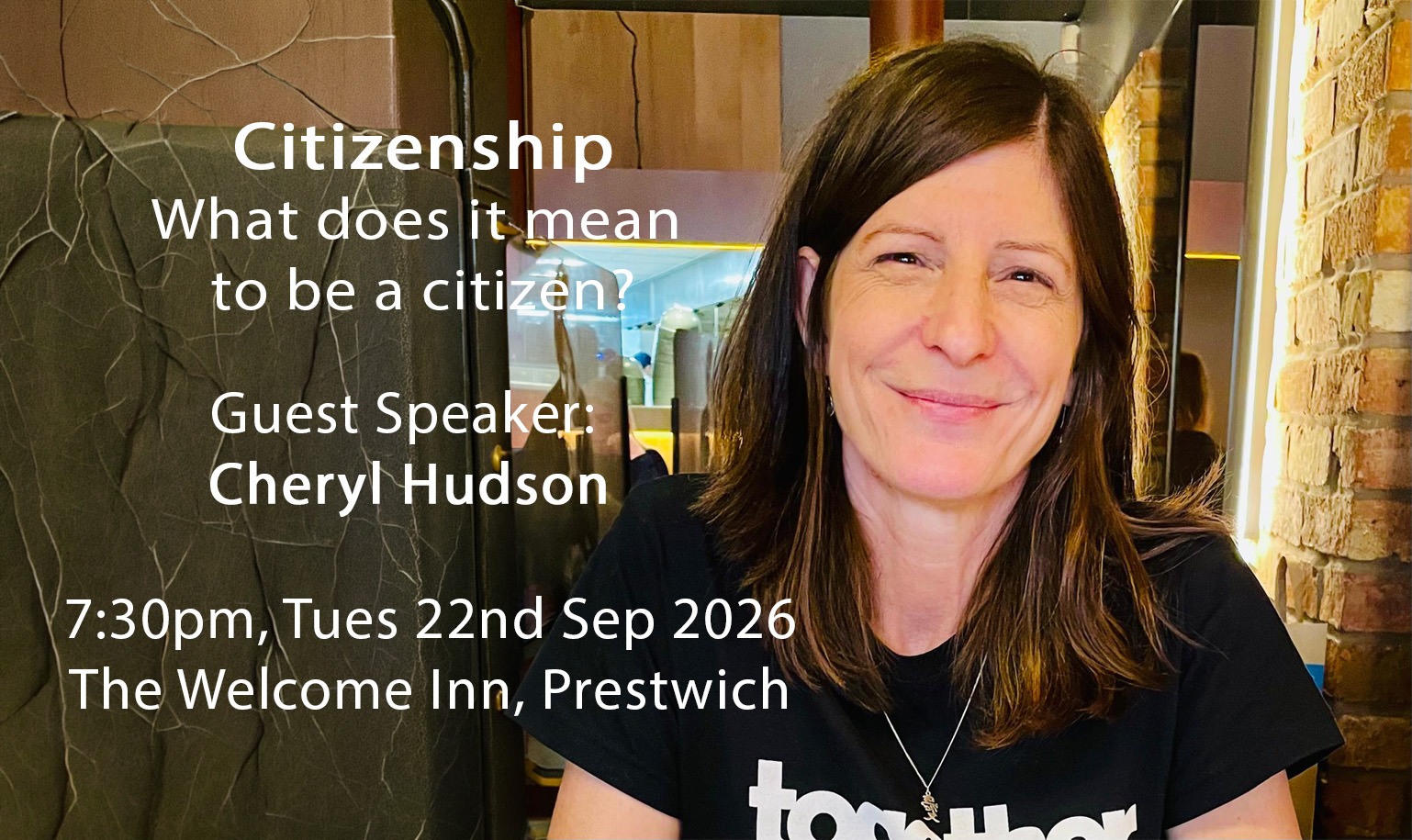
Manchester – Citizenship
On Tuesday 22nd September 2026, Politics in Pubs Manchester met to discuss citizenship. We were delighted to welcome our guest speaker Cheryl Hudson, lecturer in U.S. political history at Liverpool University.
Introduction
Citizenship is one of our oldest political ideas – but what does it mean to be a citizen? Today’s upheavals are the culmination of arguments fought for well over a century, revealing much about what holds a nation together. The votes for Brexit and the rise of Donald Trump have thrust this question to the centre of political life. This talk traces the meaning of citizenship across history – a category pulled between competing promises of rights and obligations, equality and exclusion, the individual and the community – and asks who has it served? How have immigration, race, culture, and class tested its boundaries?
What is citizenship?
Cheryl began by explaining that defining citizenship is not easy, partly because it evolves over time. The legal and constitutional rights and responsibilities we gain from citizenship are a useful reference – e.g. our rights to vote, own property, expect due process, and our responsibility to fulfil civic duties like jury service or military conscription. Our cultural sense of belonging to a place or nation state alongside our fellow citizens also plays its role in our imaginations and in our shared institutions. Yet in the UK citizenship is no longer restricted to birthright. And, until recently, Britons were categorised as EU citizens too. So our perception of citizenship can be influenced by a number of things.
Individuals and community
The imagined relationship between individuals and their national, sub-national and trans-national communities is not held in common by all citizens. This relationship too has changed over time. In the past citizenship meant universal equality e.g of rights and obligations. This allowed people of different backgrounds to co-exist on an equal footing: for example when the US gave birthright citizenship to all regardless of race, and France’s national motto: liberty, equality, fraternity for all.
Equality or inclusion?
But in the Western world during recent decades the status of equality has been deliberately converted into ‘inclusion’ by the New Left. The privileges universally associated with citizenship have been divided by the state into three distinctive categories: civil rights, political rights and social rights (e.g. the right to education, housing and welfare support). The rejection of universalism by our social institutions in order to focus on people’s differences and ‘inclusion’ has had the effect of turning people into ‘clients’ of a swollen state. This has led to disenchantment and identity politics, and isolation and powerlessness among citizens. Established associations which are independent of the state – such as team sports, trade unions, political parties and the church – have all seen a reduction in membership. Dependence upon the state has become a poor substitute for active citizenship, withering people’s own sense of agency by reducing them to passive recipients. This dependence corrodes their sense of democracy, leaving them dislocated, suspicious and hostile towards the state. Our true task today is not to be ‘included’ but to be the active authors of our own citizenry.
Discussion
Q. What is the main difference between citizenship and nationality?
A. Nationality is mainly our sense of belonging and rights associated with that. It overlaps with citizenship in a modern nation state. We are born into a nationality although we can be naturalised into another. Citizenship would emphasise our civic obligations e.g. to actively participate in that nation’s political system by voting or standing to represent others or even discussing its virtues with fellow citizens. Modern citizenship is based on our membership of a national political community. National identity is more of a cultural thing.
Q. If citizenship requires active participation in civic life, how should we categorise workless families (e.g from former mining communities in Wigan) who are not engaged in the church or any other associations?
A. They are the consequence of the New Left’s expansion of social rights which has replaced active citizens with passive recipients. Civic society is the space between the state and citizens – the space which would usually be filled by the associations of active citizens.
Q. Have some associations also let down citizens e.g. Trade Unions which no longer represent the rights women?
A. Yes – some trades unions no longer represent workers either.
C. The state creates citizenship – e.g my pound is the same as your pound – but allows it to be undermined by the market. The Beveridge welfare state was based on a democratic principle – equality of rights to a state pension from a duke to a dustman. But that notion of equality is being attacked by means testing and special pleading in tax allowances in the name of inclusion. The conversion from equality to inclusion has caused our civic institutions to fade – we need to re-create them.
Q. In nations beyond the West, citizenship is much more ethnic and civilisational. For example in Egypt, India, China and Japan people aspire to be better and have an advantage over others. They are much more interconnected and share a grand project to build something better, not just to help the next generation like we do in Britain. Wouldn’t it be better if we had aspirations like that here?
A. Social coherence is definitely an issue here. Democracy in America works because of their vast array of civil associations – people meet in these associations. They work out how to get along with small adjustments, and develop a common understanding which creates a glue between the membership. There is no democracy in China though.
C. The changing nature of citizenship is confusing – am I a citizen of a city like in ancient times? Why is it different to my nationality? Why can someone be a British subject but not a British citizen?
Q. You said the state is undermining its citizens by doing what citizens should be doing. Prior to World War Two society was stronger because of its associations – trade unions, mutual societies and stronger local communities. Now it is undermined by the NHS and welfare state. We could look at our interaction with the state from the perspective of other nations but in some of them duty to family and religion take priority so their people are not likely to become active citizens if they settle here which is another problem to contend with.
A. We live in a mass society which has moved on from nostalgia. The administrative state has been efficient but it has also utilised the differences between people in order to minister to them and we now no longer trust them. Democracy needs to be fuller, more active, more political. We can’t really go back to having associations, so we have to find out how can we make active citizenship work in the modern day.
Q. In other countries their people are individualistic but it is based on solidarity, a loyalty to the nation and a focus on building a better generation. Why are our common bonds so weak here?
A. National citizenship needs a purpose for building something better for the future. In the West we live in an ever present ‘present’. And the concept of national identity has been shamed by the New Left labelling it as ‘fascism’. As a result we have no collective vision for the whole society.
C. Western Europe and the US are more fragmented because they have a pride in their citizenship. Whereas other nations like Egypt, South Korea and China have a national pride which we would regard as nationalistic. The state has encouraged us to become ashamed of our feelings of national pride. It helps to keep us docile and inhibits the growth of active national groups.
Q. Is it possible to have successful active citizenship without having an ‘other’?
A. No, because citizenship is about a bounded community – we need to know where we belong and where others don’t (unless they naturalise). Citizenship is a political status not a cultural one.
C. National identity still matters to people even though the state tells us it doesn’t. Converting us into clients has not been entirely successful. We definitely need a collective view.
For those wishing to find out more, Dr. Cheryl Hudson’s book is called ‘Citizenship in Chicago: Democracy, Race, and the Remaking of American Identity 1894-1924’. Politics in Pubs would like to thank Cheryl for inspiring us to re-consider what citizenship really means. Thanks also to our excellent hosts at The Welcome Inn. Cheers all!
Upcoming events
All our future events are advertised here: Upcoming Events.


