
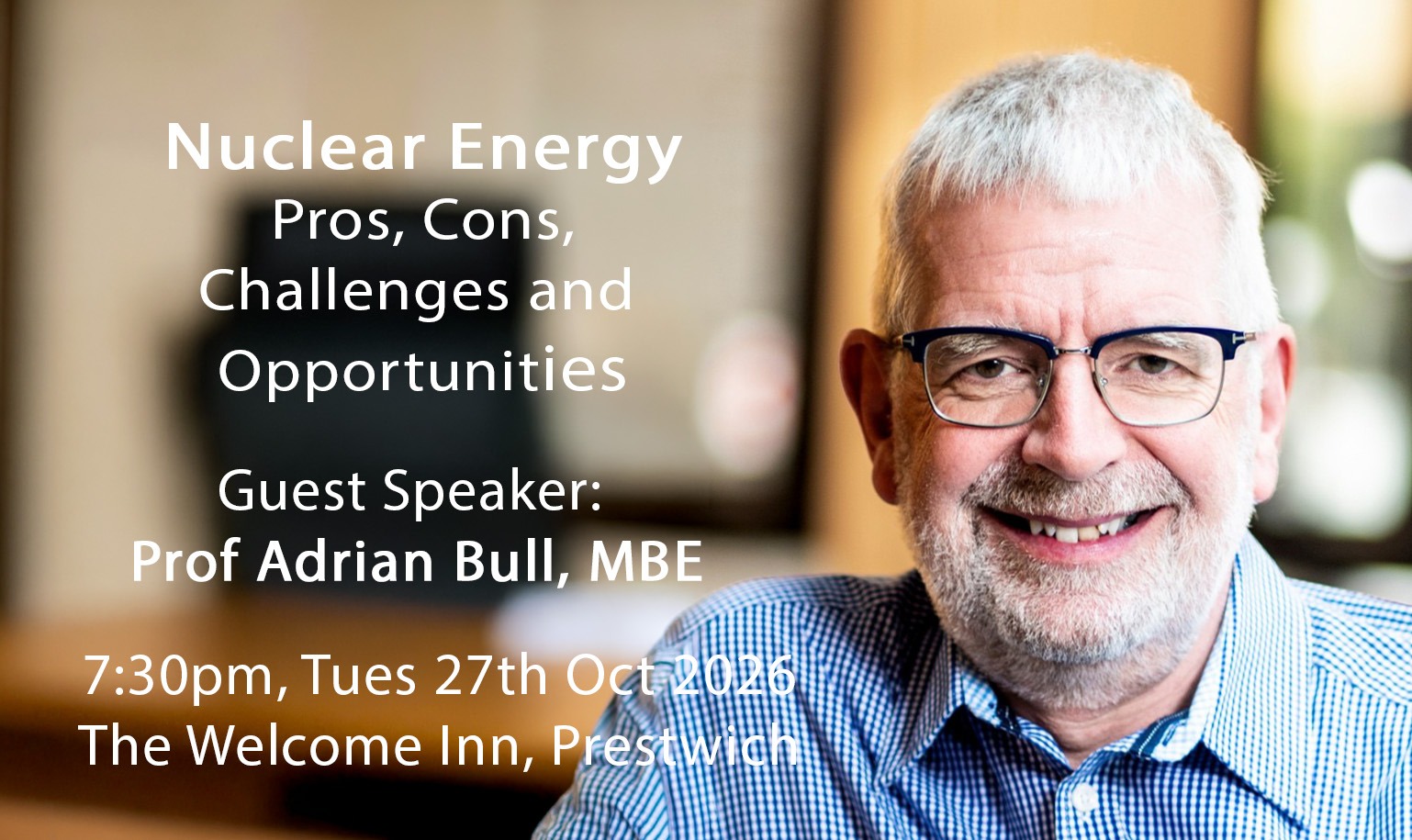
Manchester – Nuclear Energy – Pros, Cons, Challenges and Opportunities
On Tuesday 27th October 2026, Politics in Pubs North Manchester met to discuss the contribution of nuclear energy to Britain’s electricity mix, how that might change in the future, and some of the barriers and opportunities associated with nuclear power in all its forms. Whether or not you believe that there is a climate emergency, there is an increasing consensus that the only route to both reliable and carbon free energy is via nuclear power – do you agree?
We were excited to welcome Professor Adrian Bull. Adrian is an Associate Director at the Dalton Nuclear Institute, part of the University of Manchester. His focus is on Government policy around nuclear power and energy, and on a stakeholder and community engagement on nuclear issues. Prior to academia, Adrian worked for four decades in the UK nuclear industry for BNFL, Westinghouse and the National Nuclear Laboratory, where he was the External Relations Director for 10 years. Adrian is also the President of the UK’s Nuclear Institute (the professional membership body for the nuclear sector) and a Senior Advisor at US-based nuclear communications consultancy Full On Communications.
Introduction
Adrian began the session with a question: where was Britain’s energy coming from at 3pm this afternoon? The largest share (48%) of the generation mix was coming from wind power, not surprising on a breezy day like today. However, the generation mix varies throughout the year. And even though energy from nuclear power may help the UK to meet its Net Zero targets by 2050, its contribution to the mix is consistently smaller than from other sources.
Current prospects for nuclear power
The large nuclear power stations at Hartlepool, Heysham and Torness are due to close in 2030. Sizewell B is due to operate until 2055. The large new build coastal power station at Hinkley Point C is due to open in 2030, followed much later by its replica, Sizewell C. The Government is now looking at the application of Small Modular Reactors which are more flexible and can be located inland near rivers instead of on the coast. The technology for Advanced Modular Reactors is still under development.
Small Modular Reactors (SMRs)
Rolls Royce has a long nuclear heritage (derived from nuclear submarines) and has been selected by the Government to build three SMR plants in Wylfa, Anglesey. The technology is being tested for safety before building commences. It is expected that once the first two plants have been completed (funded by the Government) the plants will become less expensive to build – and therefore more attractive to investors. Large energy-intensive companies may opt to commission their own SMRs in order to manage costs and minimise disruptions to their electrical supply.
Q. A mechanical engineer friend at Rolls Royce is very negative about the proposed SMR plants. He says the managers making decisions them have no engineering background and that the Government is merely throwing money at the project – is this the case?
A. SMR technology is well-established and the Government is committed to funding the Wylfa project although the details have not yet been finalised.
Q. Doesn’t it make sense to build the plants where there is already a grid connection, like the Nuclear Fusion Project being developed on the site of West Burton Coal Power Station?
A. Yes, although the Nuclear Fusion Project is an international collaboration for future development – it has a long way to go.
Q. Kathryn Porter, independent energy consultant, describes how Britain’s environmental regulations slow down the building of new infrastructure projects. She suggests we should buy our power stations from South Korea who have a track record of building on time and to budget.
A. Yes, legislation like the Badgers Act, and demanding regulations (national and regional) like those which have resulted in Hinkley Point’s £700 million ‘fish disco’ – aimed to protect fish from entering the reactor’s cooling grid system – can slow up development and result in considerable, unnecessary, extra expense.
Q. Has the former uncertainty around de-commissioning costs improved in recent years?
A. Yes, the post-World War Two nuclear power stations were built without little consideration for de-commissioning. These days, a full de-commissioning plan is required to get past the regulator.
Q. How do SMR energy yields compare with large scale nuclear power stations?
A. The Rolls Royce SMR yields 440 megawatts compared with the 1600 megawatts produced by Hinkley and Sizewell. It is technically larger than the 300MW threshold internationally agreed to constitute an SMR. [Is it therefore an MMR – Medium Modular Reactor? Ed.]
Why do MPs love nuclear power?
Nuclear power contributes to Net Zero because it has much lower carbon emissions than both gas and coal. By the 1990s, the UK had already accidentally reduced its carbon emissions by switching from coal to gas powered stations. And nuclear’s carbon emissions are considerably lower than those from gas.
MPs are now focussing away from clean energy and more towards energy security because of conflicts like the invasion of Ukraine by Russia. Uranium can be sourced in countries like Canada, Africa, and Kazakhstan although it takes several years to process ready for energy production.
Nuclear generates power at a predictable price for 40-60 years.
The nuclear power industry creates high quality jobs, often in remote areas where the employment is needed.
Nuclear power is a big ticket item in international collaboration talks.
Why do MPs hate nuclear power?
It polarises public opinion.
There are concerns about nuclear waste.
Power stations take a long time to build, at great expense, and they require state support. They often go over budget and timescale.
All the negative aspects of nuclear have to be endured before the positives can be enjoyed.
Q. Do you agree the tricky decisions about energy security will be made worse by the current political mood in Britain which is focused on devolution? We are generally suspicious of nuclear power and also of civil service commissioning. Nuclear seems to be the best of a bad bunch of options. A big technical breakthrough is needed to enable the best solution for Britain.
A. Generally the countries that do nuclear well are those we wouldn’t want to live in e.g. those with centralised governments and centralised utilities (like China and Russia). They have a single funding model. The UK has many different funding models which makes things much harder.
How do we differ to other countries?
The UK energy sector was a state owned single utility but it is now privatised, giving the Government less control.
We no longer have a national reactor vendor for big reactors.
Our five yearly electoral system inhibits policy continuity, resulting in a piecemeal approach to energy infrastructure and security.
Energy policy is centralised whereas planning policy is devolved. As nuclear issues concerning reactors and waste often polarises communities, subsequent planning decisions made locally can undermine national energy policy.
Our regulatory system is unique to the UK and its approach to nuclear power risk is based subjectively upon the ‘ALARP’ principle (‘as low as reasonably practicable’). Other countries set empirical limits which makes regulation much more straightforward for developers. ALARP is sensible in theory but leads to impractical outcomes which are sometimes disproportionate to the risk.
The UK has had 19 nuclear power stations based on 15 different designs. France has had 58 based on three different designs – making maintenance and repairs easier.
Q. There seems to be a very low level of scientific knowledge in Parliament and among the civil service – are they really capable of making decisions on these complex matters?
A. Our civil servants often have to move from one department to another in order to advance their careers, so there is a fast turnover of staff and specialist knowledge is lost from the team. The US equivalent does things very differently and the continuity works much better for running the country.
Q. Britain seems to have been much better 50 years ago – but we can’t even build our own power stations any more and are obliged to go to foreign providers. Have we lost the skills lock, stock and barrel?
A. The French company EDF, which is building Hinkley Point C, encouraged British suppliers to get approved for EDF’s supply chain. But our Government’s piecemeal approach to energy made it seem like Hinkley might be a one-off infrastructure project and the suppliers decided it wasn’t worth the time and costs associated with getting approved.
Q. Isn’t it also true that the designs keep changing because of ALARP?
A. Yes, the industry needs to push back on the regulator, particularly on when the regulator’s requirements are not ‘reasonably practicable’.
Q. Have the new planning regulations been relaxed for new big infrastructure projects?
A. In theory, yes, but the problem is that nuclear power projects often get bogged down in related matters e.g. approval for service roads, harbours, gridlines etc. This is made worse when gridlines cross council boundaries and their corresponding environmental assessments.
Q. The battery storage facility being built at Doncaster is expected to connect to the National Grid in seven years’ time. Aren’t large businesses more likely to build their own SMR rather than wait the seven year period?
A. Many data centres are already looking at having their own SMRs for that reason. Plus it will create high quality jobs, potentially off-setting the unpopularity of having the data centre in the local community.
Q. There are between 70 and 90 data centres planned for the UK. The National Grid does not currently have enough capacity. Is there a Government plan to address the extra energy demand?
A. Could anyone in the room hazard a guess at the answer?
Q. Nuclear power is like socialism. France gets 60-70% of its energy from nuclear power and they said it would be so cheap it wouldn’t be worth metering. But French consumers only pay 30% less than we do, so it’s actually very expensive. The ownership costs of de-commissioning are picked up by the tax-payer equating to £374,000 per hour for a period of 12-20 years. The stats reported by ONS on the cost of nuclear power don’t stack up. Renewables can produce a lot of energy but the storage problem needs to be resolved. Our Government energy policy is rubbish and the cost of nuclear power isn’t justified. Wouldn’t it be better to tax British people less and make use of our oil and gas instead of nuclear until the renewables storage issue has been addressed?
A. De-commissioning plans are much clearer and costed these days. New build projects will be required to create a pot of money ring fenced for de-commissioning. Storage of renewable source energy definitely needs to be resolved. Peak demand is between 5 and 6 pm, ten days either side of Christmas. Renewables are great but they are not reliable – back-up storage must be able to address the day to night demand and the summer to winter demand. Licences for gas extraction in Britain have been granted but they won’t reduce the price for British consumers because the gas has to be sold on the world market.
Q. If you were allowed to be the Prime Minister for thirty years, with no budget restriction and no Net Zero legal obligations, what kind of energy system would you commission for Great Britain?
A. A system providing two thirds of Britain’s energy from nuclear (specifically Rolls Royce SMRs and, say, a Westinghouse reactor), and the remaining third from North Sea gas and wind, solar, tidal renewables (with built in storage facilities).
Q. Kathryn Porter is convinced that due to the unprecedented set of Electricity Margin Notices issued by NESO this summer, that we should be asking how likely is it that we will see the lights go out this winter?
A. Very low. Energy companies are incentivising consumers to avoid using energy during busy times e.g between 6pm and 7pm which should help to reduce demand.
Politics in Pubs North Manchester would like to thank Professor Bull for leading an absorbing discussion of nuclear power. Thanks also to our wonderful hosts at the Welcome Inn. Cheers all!
Upcoming events
All our future events are advertised here: Upcoming Events.


